April 1, 2014

A look at Port Connectivity

No fooling this (1.4.14)!!!

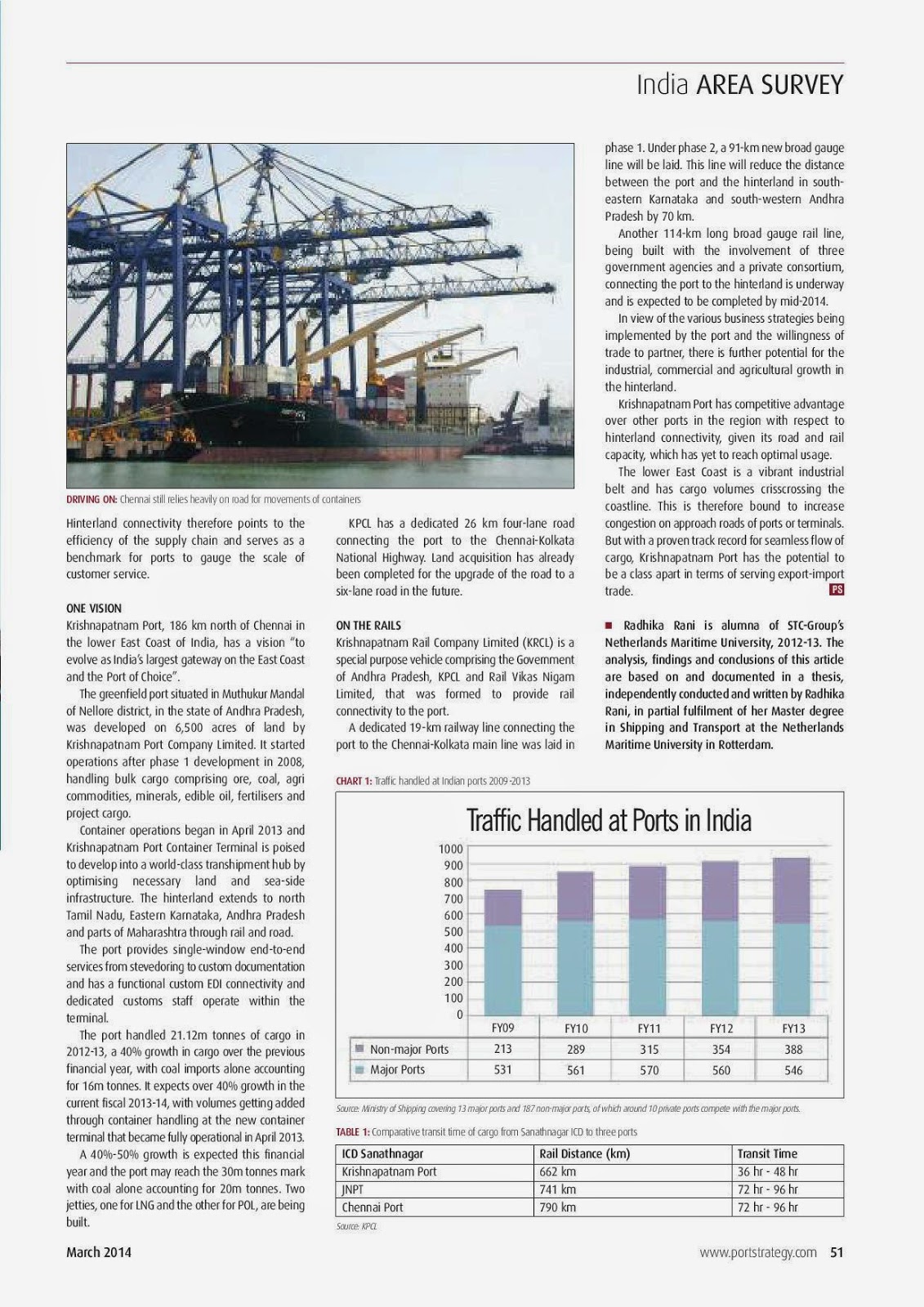
Here's an article that was published in the March issue of Port Strategy and later on, on their website.
http://www.portstrategy.com/news101/world/asia/tipping-point


February 6, 2014

From Ignorance to Awareness

While recommending Martin Stopford’s Maritime Economics to a colleague, I was drawn to pouring over the pages again - the last time I did was during my Masters. Oh, boy! It is so refreshing to read him again. No wonder, one of my Korean friends is so keen to translate the book for the benefit of the Hangul readers. In the chapter ‘Bulk Cargo and the Economics of Bulk Shipping’, Martin reels out simple statistics of a typical bulk transport system:
  • 1 sea voyage and 2 land journeys
  • 4 storage areas located at the origin, the loading port, the discharging port and the destination
  • 8 handling operations as the cargo moves in and out of the 4 storage areas
  • 4 loading/unloading operations from land transport vehicles plus the ship loading and discharge
  • 14 times of cargo handling between the producer and the consumer

“No wonder transport system designers are so interested in finding ways to reduce this cost,” he sums up.
Source: Martin Stopford, Maritime Economics 2nd Ed

This is just an example of his eye for detail and description. Elsewhere, he says a country’s pattern of sea trade depends on three variables – GNP, the stage of development and natural resources – and the character of trade changes as the country develops. He terms this as the Trade Development Cycle.

The book is worth a read for those interested in understanding the dynamics of maritime trade.

A visit to Hamburg at the turn of the decade and Martin’s presence in a gathering there meant meeting just another guest. Oh yeah! Blissfully ignorant!

For a quick sustainability report at Krishnapatnam Port, please access: http://www.krishnapatnamport.com/data/Sustainability_Report_2016-17.pdf

February 5, 2014

At India Maritime Week 2014


Big Prospects, Big Challenges, India Marching Ahead. Yeah, the picture says it all...
At the 3rd India Maritime HR Summit as part of the week-long event.

January 10, 2014

Sharing My Experience At the Graduation Ceremony


Here's the video link to my speech. My Graduation Speech 

The video was shot by my friend Vazhi, who lives in Paris, France. He came all the way to Rotterdam, with his two little daughters.

The articulate ones among the graduating students were invited to speak at the NMU Graduation Ceremony. Incidentally, the two of us were class toppers. Many of the classmates, who had either rejoined/joined work, could not make it to the big day. Another ceremony is scheduled in March this year.

December 6, 2013

Self-discovery and a sense of fulfilment


"Getting a degree is, no doubt, a proud moment. But the journey and the process that lead to the graduation moment coming alive, is more important and interesting. The little things that we learn and do step by step, add up to the person that we are today." These lines were part of my graduation speech. Graduation Day is only a colourful and momentary fullstop to a focused study at a moment. The learning process, however, has to go on... In the process, self-discovery and fulfilment!

Thank You, Netherlands Maritime University, Rotterdam, for the wholesome experience I have had.

August 25, 2013

Korea - The Epitome of Yin-Yang

An Essay written in October 2012 that fetched me the Gold Prize from Korea's Ministry of Foreign Affairs and Trade. 

http://radhikarani.blogspot.in/2012/12/prize-for-my-essay.html

Coexistence of modernity with tradition, opened-up markets with closed sectors, conservative ideals with liberal ones, irreligion with religious fervour, bibimbap with burger, mountains and valleys, bright summers and dark winters, vital earth and vibrant sky, and many more contrasts of sorts are all complimentary to the balance of things and add to the cohesive fabric of Korea, offering interesting insights to foreigners!

by Radhika Rani G.


Upheavals followed by glorious times in human history symbolise the sapiens' incredible spirit of grit in the face of gripe and their innate nature to rise like a phoenix. The sprouting of  inspiring civilizations from the cyclical process of war and peace through the ages is a testimony to this fortitude of men and women, and in the larger context, of communities and countries. As nations free themselves from strife and as they strive, despite disadvantages and inadequacies, to weave a dynamic social, economic, political and cultural web, all pointing towards progress, they stand out as an awe-inspiring harmonized whole for the world. While they race against time to rise above themselves and raise generations of strong-willed citizens, their metamorphosis tells a tale of the triumph of the human spirit -- of great expectations and accomplishments. The saga of Korea, that has since come a long way from the 'Hermit Kingdom' to the 'Democratic People's Republic' is indeed an uplifting story of contrasts and offers a lesson or two for people far and wide.

The Asian Tiger

The Korea of today, making waves as a high-income developed country, one among the G-20 economies and an Asian Tiger alongside Singapore, Hong Kong and Taiwan, draws attention to 'the Miracle on the Han River' - the growth story as termed by its people. Let us not forget that the 'Tiny East Asian Giant' was roiled in war not long ago, six decades ago to be precise, remaining as one of the poorest countries in the world through the 1950s and 60s. But working its way up through a clear vision and emerging as a market economy, ranking today as the 15th in the world by nominal GDP, 12th by purchasing power parity, 7th by global exports and 10th by imports, speaks of the leadership-driven economic development. This growth, marked by low state debt, high fiscal reserves and strong loan portfolios of banks, is in turn lending resilience to the economy, through thick and thin.

With hardly any natural resources to boast of except for mountains on the mainland and seas around the coast, it is indeed remarkable that labour-intensive manufacturing and industrial development, supported by government initiatives and foreign investment flows, have taken the growth chart of the peninsula to new heights, as also the income levels of its people. As per 2010 figures, the GDP per capita is $30,000. Contrast this to a mere $2300 in 1980.


Notwithstanding the Asian Financial Crisis of 1997, the country's GDP growth within the three decades went up from $88 billion to $1,460 billion changing its status from being recipient of official development assistance to being donor, to nations in need. Making good with what it has, the country has been able to reap benefits -- reaching a GDP of 2.6 per cent in agriculture, 39.2 per cent in industry, comprising electronics, telecom, automobile production, chemicals, shipbuilding, steel and 58.2 per cent in the services sector, comprising financial, health services and social infrastructure.

Given the closed services sector, a lull in the demand for exports in the wake of the continuing global recession and jobless rate of 3.4 per cent for a 73-million plus population, will the nation sustain its growth for long, is a question bothering none other than the Finance Minister Bahk Jae Wan. Fear of competition from foreign rivals in the services sector is a matter of concern for the government now.

The minister could be right. There is a need for innovation in the bipolar economy, to keep the symbolic 'Korean Wave' swinging on the global turf. Pleading his countrymen to dream big and work towards building their country's international brand image, the minister has recently cited Psy, the singer of the global smash hit Gangnam Style, as an example of the kind of "creativity and international competitiveness" the country needs. Yes, time for reinventing K-Band and K-Brand!


B(r)and Korea

Hyundai and Samsung sound like Tata and Birla of India or Audi and Opel of Germany. Life in Korea sings and swings to the two brands, that make for interesting case studies and discussions on brand building in B-schools. For a beginner in Korea, all things Samsung on a first glance -- from mobile phones to vacuum cleaners -- seems a pleasant surprise. But such is the power of this Chaebol or conglomerate whose net income runs to US$ 18.3 billion. Three Stars, three cheers!

Well, the growth stories of other brands too, like LG, Daewoo, STX, sum up the focus and the drive of the people heading these giants. The industriousness of the 25 million working force of Korea, known to work the longest hours per year and so ranked as the world's hardest working country in 2008 by the Organization for Economic Co-operation and Development, substantiates the speed of success that the Korean enterprises achieve in little time, when compared to global counterparts.

Think Korea, think K-Pop. This adage sounds and seems true on switching on to the television. That the musical genre consisting of dance, electronic, electro-pop, hip hop, rock, and R&B music is a popular mode of expression and entertainment for the youth and unique to the country, is anybody's guess. The viral media and Youtube views around the world have been creating teen idols out of nimble dancers and singers. 

A contrast of sorts though is the 34-year-old portly rapper Psy, who, despite hurdles, has jumped his way over through his own brand of talent, that worked wonders all the way to fame. As recently as September, Gangnam Style was recognized by the Guinness World Records as the most "liked" video in YouTube history with 480 million views. The tune and the dance moves have become a hit in many countries. Way to go for Psy and perhaps, a way for other pop aspirants to explore!


Food Funda

Homes, gardens, clothing, cuisine, festivals, games, beliefs, mythological shows on TV add to the curiosity of foreigners. However, food is what tickles the palate, the most. If coffee shops dotting busy streets are an instant eye-catcher for new-comers and could hook them on to the chocolate drink, the literally evergreen gimbap and kimchi and other traditional gastronomic delights served in eateries satisfy the taste buds of all and sundry, any day! That the life expectancy of the people is around 79 years and the degree of obesity is only 10 per cent speaks for the healthy food habits of the people.

A quick study of the menu in a decent restaurant shows the basis of the Korean diet as being low-fat comprising of tofu, noodles, fish and vegetables. Kimchi -- seasoned with lots of hot spices pickled vegetables -- and taken as a side dish at breakfast, lunch and dinner, leaves an effective imprint and is a name hard to forget for any foreigner!

According to an international survey, grilled beef has turned out to be the only unhealthy meal of Korean cuisine. Loved largely by the natives, it is however consumed mainly on important holidays. The survey goes on to point out that an average Korean, by all counts, eats just 3.5 kilograms of meat a year, as against the ordinary citizen of the United States who consumes 30 kilograms!

Politics & Population

With presidential elections due in December this year (2012) and the heat picking on, it is interesting to see the campaign pledges of the candidates in the media, harping on economy during the crisis. A look at the political system suggests that the government could be more open and connected towards business and increase its assistance to start-up companies, to encourage entrepreneurship and employment generation in the wake of a 2.4 per cent growth rate projected for this financial year by the Bank of Korea. Among the various industrial segments, the shipbuilding industry was hardest hit owing to the European crisis, and seven-month exports so far this fiscal stood at $38.19 billion, down 57 per cent from the same period of 2011.

According to the Federation of Korean Industries, exports by shipbuilding will fall 28 per cent, steelmaking 13.9 per cent and petrochemical industries 5.9 per cent in the second half of this year. Against this backdrop, the protectionist sentiment perceived abroad and the subject of deregulation could be addressed forthwith to restore the country's growth path.

An important issue of concern however is the decreasing population growth. "With the lowest birthrate in the world and a rapidly aging population, the growth engine that is the heart of our economy has stopped," Presidential candidate Rep Park Geun-hye of the conservative Saenuri Party remarked recently. While growing longevity calls for welfare measures, falling birth rate stands out for its urgency. According to an OECD study, the growth rate of South Korea's economy would hover around 2 per cent in 10 years, and 1 per cent in 20 years. This will indeed be aggravated by decelerating birth rate in the decades to come.

Another worrying factor is the uncertainty about the future in the masses, thanks to the fluctuating global financial condition. A recent survey by Hyundai Research Institute on Koreans' perception of class membership brought out these results: People who described themselves as poor accounted for 50.1 per cent, those who classified themselves as middle class 46.4 per cent and the upper class a mere 1.9 per cent. As for the growing skepticism on the economy from the middle class, the reasons cited in the survey were deepening polarization, continuing economic slump, lack of decent jobs, excessive household debt, unfair opportunities and unpreparedness for old age. This view, according to a recent Korean Herald editorial, depicts Korea as an almost closed society. "This is worrisome indeed as a society cannot generate the energy and vitality it needs when almost all its members feel there is little room for upward mobility The middle class is the backbone of society. If it remains depressed or contracts, it will harm social unity and deter economic growth," the editorial adds.

Job creation and thereby social cohesion for the young middle class, reduction of housing costs for people in their prime, lowering of educational expenses and increase of post-retirement benefits are issues that need to be addressed by the policy makers.


People's warmth

Despite the language barrier, given the homogeneity of Korea in terms of speaking its national language, foreigners are treated with a friendly grin and a few Hangul pleasantries by the natives. It really pays to return the warmth with an Annyeonghasey. Also, nothing seems to dampen the undying spirit of the Korean people. So, a smile is an easy and sure way to strike up a conversation, mainly with body language, given the limitations of people on both the sides. However, it is a common sight to see schoolchildren and English-educated youth to wave a Hi and a Bye. Yet, the love for the language is noticeable all around. And so is the respect for all things Korean. So after a long day's work, it is perfectly fine for one to sign off the evening with Soju and Infinite playing in the background.

More importantly, living in Korea, working with its people, getting a glimpse of the life of contrasts and leveling off things with the sheer balance of Yin and Yang, the national symbol of pride as seen on the Korean Flag, could indeed be an exhilarating experience altogether.

Kamsahamnida!


August 18, 2013

The Power of People

A Reflection Paper on HRM classroom activity

Human resources are like natural resources; they're often buried deep. You have to go looking for them, they're not just lying around on the surface. You have to create the circumstances where they show themselves.

-Ken Robinson (Author, Speaker, Advisor on Education, Creativity and Innovation)

Here is a deep-down look into the wealth within, its power and the value it delivers to an entity!


Introduction

Homo sapiens (wise men) are the highly evolved primates on this earth, showing behavioural modernity since the last 50,000 years. With the passage of time and spatial distribution, their innate trait of gregariousness led them from forming families and kinships to groups, societies and nations. As we talk of civilizations built over the past, we recognise this collective identity of human societies in community relations, trade ties and global interactions. All along, we acknowledge that man is a social animal both by nature and necessity and that he will continue to be so. The methods of adapting to greater complexities, diversities, competition, innovation and expectations might change and the means of communication in the wake of newer technologies & inventions might turn sophisticated. But the core of his existence - social identity and collective consciousness - will be intact and focused on driving societies to enhance their performance as 'human resources' or 'workforce' contributing to the progress of the human race in general and the business or the social milieu in particular.

The significance of people as the power, asset and value to collective goals is growing as countries and businesses compete to become productive and progressive while adapting to change and uncertainty. This reflection paper seeks to understand and appreciate the underlying importance and influence of human resources examined during the recent classroom sessions, group discussions and team projects, and by studying the fundamental theories, concepts and motivation governing human resource management and development in organisations.


Fundamental Theories

Motivation is a fire from within. If someone else tries to light that fire under you, chances are it will burn very briefly. -Stephen R. Covey

Maslow's Motivation Theory, or Hierarchy of Needs, identifies the basic types of motivation and the order that they generally progress as lower needs are reasonably well met. It is interesting to take note that the later theories - of McGregor's X and Y, Herzberg's Two-Factor Hygiene Theory and Tom Peter & Robert Waterman's McKinsey-7 S Model - are based on Maslow's motivators and attempt to show the driving force of an individual's performance and satisfaction. They draw the general belief that people are motivated in three ways - material, social and ideological. However, barring authoritarian style for unmotivated employees and participative style for motivated staff prescribed by McGregor, self-actualisation by Maslow, characteristics like achievement, recognition, responsibility, work itself, advancement and growth put forth by Mintzberg and the 7 Ss - the soft and hard elements of the McKinsey framework - incline towards the internal driving forces of individuals, what Stephen Covey refers to as the 'fire from within', that actualises a company's vision, mission and policies. 

Let us study this aspect further in today's context. In a recent survey on 'The 100 Best Companies to Work For in 2012' done by CNN Money and Fortune Magazine, the web search company Google was rated the best while the Intercontinental Hotel Group stood at 100. Google says its culture is: "We hire people who are smart and determined, and we favour ability over experience. Although Googlers share common goals and visions for the company, we hail from all walks of life and speak dozens of languages, reflecting the global audience that we serve. And when not at work, Googlers pursue interests ranging from cycling to beekeeping, from Frisbee to Foxtrot." This is an example of a firm focusing both on its employees and stakeholders, while promoting innovation, creativity, work and play! Input-throughput-output is the company's systemic approach. Google staff say, "Independence of work, absence of red tape and freedom to disagree makes it a wholly different workplace." 

Coming back to the fundamental theories deduced by our scientists, we realise that apart from the bottom line that almost everyone work for money and thereby seek material possessions and pleasures to lead a decent life, people want more from work than just money. And that this 'more' could be reward, recognition, respect and elevation. We come to comprehend that people have the innate urge to learn things and excel and this drive is what differentiates the efficiency and productivity in them and the leader from the led. But the most telling aspects of motivation - esteem and value - come from the basic premise that humans are more social beings and that they continually seek to satisfy the urge of seeking appreciation, both in personal and professional spheres. This trait of recognition applies to both employers and employees. The theories therefore help us understand the intrinsic and extrinsic motivations and how the marriage of the two can help build successful, sustainable and motivating work environments.

Organisational Concepts

Management is nothing more than motivating other people. -Lee Iacocca

We know that an organisation involves tasks and how they are divided, grouped and coordinated by managers. This concept is explained by Mintzberg's Model on Five Generic Structures. Also, key organisational variables such as purpose/goals, people, tasks, technology, culture and external environment show the processes involved in creating a structure. An organisation, based on these processes and on the nature of its activities, can choose to have a functional structure, a product-base, geographic, divisionalised and matrix set-up. It can also choose to have a centralised or a decentralised type of management, with a top-down approach and a line-staff method.

With all these in place, there are certain immutable laws or stages that every organisation must go through and needs to do to go to the next stage of growth such as decision making, goal setting, alignment and accountability, says Les McKeown in a video lesson shown by the teacher during the class. As regards Predictable Success, which is also the name of the business growth methodology and the company he heads, McKeown says, "Success in business is repeatedly making good decisions and effectively implementing them." Each organisation makes its own decisions that come out of policies that are made to uphold its mission, hierarchy, management style and human resource management. Taking this a little further, we notice that companies, to carry out specific tasks, develop project management structures governed by authority, delegation, control and health check devised on certain methods (such as Prince2 or Gantt). More importantly, key performance indicators tailored on the acronym SMART objectives (Specific, Measurable, Attainable, Relevant and Timely) measure the amount of change or progress achieved. Also, we see companies developing their own HR policies and strategies with the objective of value addition by way of recruitment, training, performance management, development, job evaluation and even dismissal. 

While we see horizontal and vertical work relationships put in place in organisations, Les McKeown argues that managers, who generally work in a proprietorial sense, need to be trained to work laterally or with peers, to link arms and to pass the baton from one to another. Such a concept works well in harnessing leadership across the organisation. "We operate inside what we know we know. What we get challenged is to get to understand more about the stuff we know we don't know," says Les McKeown. So, to reintroduce vision or the concept of adding value or taking initiative within a structure, organisations have to review and work on concepts that help in team-building and facilitate communication and adaptability to the changing demands and expectations.
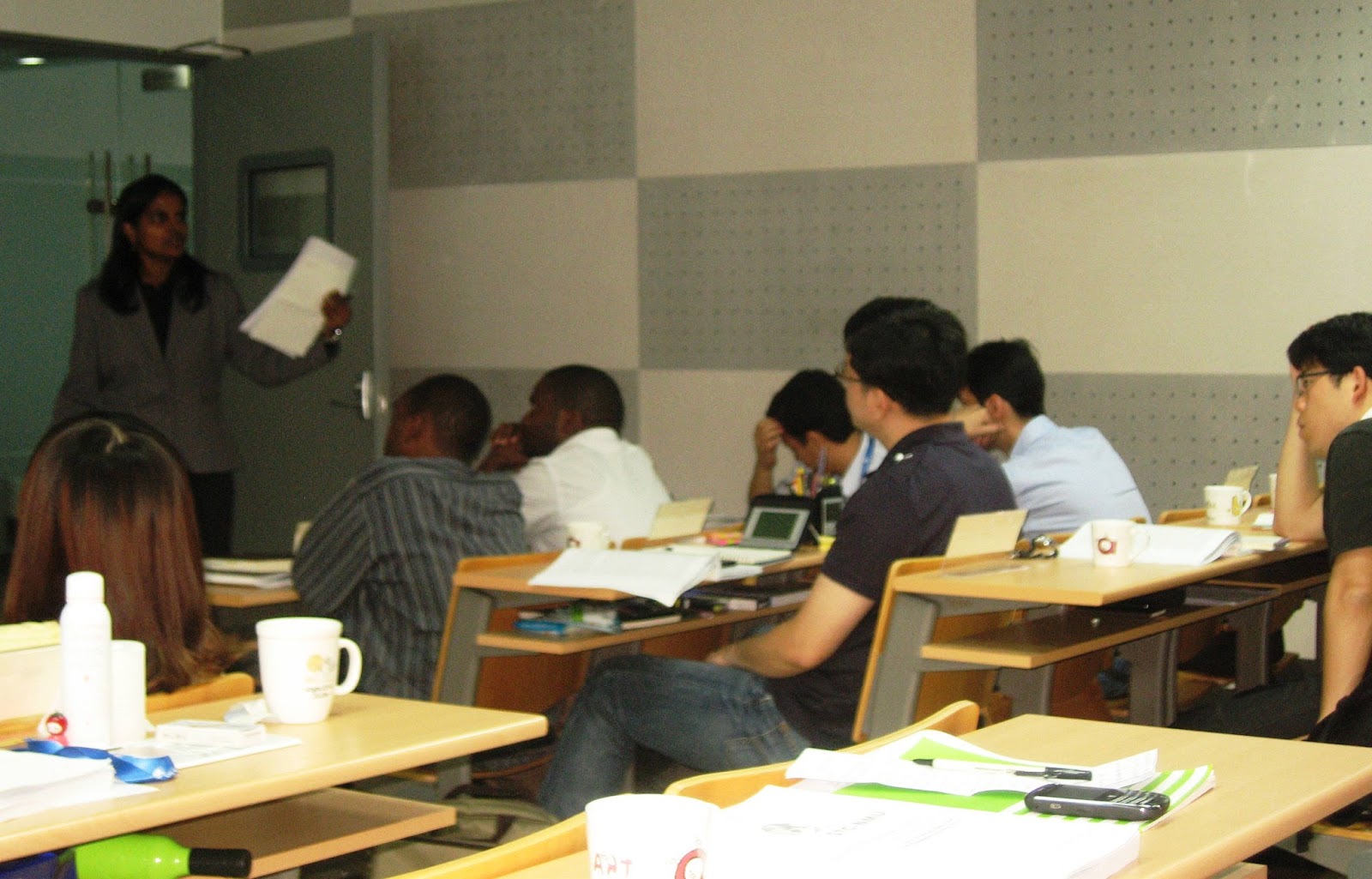
United we walk the talk! The class in rapt attention.
Function & Behaviour

What you do speaks so loud that I cannot hear what you say. -Ralph Waldo Emerson

While it is interesting to debate whether leaders are born or are made, it is observed that leadership styles, some natural and others acquired, can be honed as per the organisational need. While 10 leadership styles have been identified and discussed during the classroom session, we find that whatever be the style, from transformational to transactional, effective leadership requires a challenging vision, strategic thinking, a broad mindset and trustworthy relationship with the team, more so today as organisations are becoming less stable and predictable. In this regard, Dr Meredith Belbin's research on using psychometric measures to analyse leadership characteristics in people is commendable. His work is based on the belief that behaviour and interpersonal style of a person within a team is to an extent dependent on situations and circumstances. His model on team roles helps team leaders and development practitioners create more balanced teams by blending people of diverse characteristics and getting the best out of each. 

Belbin's nine team roles, each associated with typical behavioural and interpersonal strengths, fit into three groups: 
• Action-oriented:       Builder, Organiser, Finisher
• People-oriented:       Chairman, Supporter, Explorer
• Thought-oriented:     Innovator, Warner, Specialist

For all the leadership styles and team roles to drive the message and achieve results, communication is the key - be it in oral, written or non-verbal form. Technically, a written communication process that is quite commonly used in organisations involves a sender, message, channel, receiver, feedback and context. When this chain is active, it is important for both the sender and the receiver to ensure that their message and feedback follow the 7 Cs - clear, concise, concrete, correct, coherent, complete and courteous. While oral communication, such as a one-to-one or a group talk, helps during learning processes and tough situations, non-verbal communication is generally important in all situations as human emotions, gestures, posture and movements amplify a message. 

According to social scientists, body language makes up about two-thirds of all communication between two people or between a speaker and a group of listeners. While barriers to effective communication such as prejudices, stereotypes, emotions and drifting away while listening need to be guarded against, targeting at the larger picture of the organisation during communication, especially during an argument or heated discussion, works well both for the individual and the team.

Maritime HRM 

They all have excellent resumes... So what I’m trying to find out is how they will behave under pressure. -Hyman G. Rickover

The maritime industry, especially the shipping and the logistics sectors, are international in nature and linked directly to world trade and economy. With a vast scale of operation, team work, special requirements, rules and risks involved in the work and challenging situations thrown in, these transportation sectors require qualified personnel with adaptable or situational style of leadership and communication skills to reach out to diverse teams. However, the issue of shortage of qualified, competent and motivated officers continues and the shipping sector is in need of men and women of able leadership to drive teams, though it has a surplus of ratings and other subordinate staff. 

Environmental challenges, demands for more efficient shipping and advanced maritime operations in the industry will increase the demand for specialised human resources, both on shore and on board  ships, observes the Norwegian Shipowners' Association, an employer organisation. For instance, growing demand from specialised fleet in the high-growth offshore industry calls for expertise in seafarers and engineers. Given this imbalance between demand and supply, the recruitment, training and retention of personnel with the right aptitude is a crucial task for human resources managers. Of late, working amidst amendments to STCW, port state control, new IMO guidelines, ISPS Code, IMDG-Code to tap talent is quite a task for HR managers.

Factors like opportunities in other allied fields on shore, stringent competency norms governing sea transport, absence from family, enormous paper work, fatigue and risks like piracy and criminalisation are leading to a reduced career span of seafarers while deterring new recruits into the sector. In a way, high attrition rate is affecting leadership in the sector. Given these travails of trade, the industry and UN agencies are bracing up with the 'Go to Sea' campaign.  

Classroom activity

There is no doubt that creativity is the most important human resource of all. Without creativity, there would be no progress, and we would be forever repeating the same patterns. -Edward De Bono

The classroom action involving discussions, sharing of thoughts and viewing of educational films during the HRM module was a welcome relief from regular sessions. A discussion on the mission and the vision statement for an organisation set the stage for a debate on the need or not of a mission statement, a la House of Commons. This exercise, depicting no less a Parliament session in terms of the decibel levels, was indeed a warm-up to the vocal chords and the brain to take on other team assignments during the week! The following video lessons shown by the teacher had practical insights to offer to the students: Videos on Belbin's team roles, Les McKeown theory, McKinsey 7-S framework, Apple's mission statement, a manager's view of the employees of a company, Charlie Chaplin's production times, funny job interviews, interviews using STAR technique, performance appraisal interview, comic dismissal, leadership and motivation aspects, communication skills, active listening, win-win negotiation, life on board Edith Maersk and Dr Myles Munroe's 10 attitudes for leadership development. Understanding the difference between leadership and management, training and development, groups and teams, by way of exchange of ideas was also a helpful exercise.  

The role play of a job interview enacted in the classroom was both amusing and informative for the rest of the class. "The best indicator of the future behaviour is the past behaviour." This message echoed by James Manktelow and Emy Carlson of MindTools.com helped while framing questions on the past challenges faced by a recruit and his evaluation for the job ahead, using the STAR format. The teacher also led the students to identify the individual management style based on a questionnaire that tests the situational behaviour. This helped the students to ascertain themselves in four quadrants:

Also, the negotiation for salary hike between the Nautilus union and the management team of the shipping company Rotterdam's Best initiated the students into the art of communication across a negotiating table and this conflict management exercise showed how a bargaining process is crucial for forging win-win relationships between the management and the employees. The exercise also drove home the point that despite the management's sharp eye on finances - costs and profits - good preparation, sound information, ground rules, bargaining and problem solving skills, effective closure, expected outcomes, possible solutions and a decent way of agreeing to disagree, are the key for a positive negotiation. The need for sufficient attention to mutual respect in inter-personal communication helps in building rapport between the divergent teams within an organisation where members should ideally thrive on healthy relationships.

Practical issues related to HRM such as culture and its implications, especially during acquisitions and mergers, and crisis management situations dealt by the teacher brought to fore the need for understanding team dynamics for the success of the task and the team.
Do It!
Team Projects

Talent wins games, but teamwork and intelligence wins championships. -Michael Jordan

While all team projects culminated in the presentation of thoughts and ideas in the class, it was, as always, a learning experience to work as teams 'backstage' in preparation for the final show. Brainstorming on the contents of the task, jotting down ideas, coming to a consensus on the outcome and taking turns to present the results to the class was an exhilarating exercise as most of the assignments were partially spontaneous and so needed quick reflexes! 

The team assignments included 'Why do companies need mission statements?', 'The vision and mission statement for a maritime company,' 'Is staff turnover good or bad?', 'What are the differences between shipping 50 years ago and now?', 'An exercise in non-verbal communication and the results thereof presented as answers to questions' and 'The best leadership style for a ship captain; the generic and technical competencies of a chief officer'.

The formation of three teams in the class with members distinguished by defined characteristics, based on the score they received in Belbin's team role questionnaire cleared the decks for the ongoing mega human resources project. With the approval of the plan outlay by the teacher for the 'Employee training/orientation/recruitment packages' - the three projects being developed by the respective teams - the human resource management session reached a logical conclusion. It allowed the students to get their act together for the assignment and to realise the importance of their distinctive roles and thereby their valued contribution for the success of the project. 

In all, the human resources management module brought to fore the vast potential of people as change agents for businesses and organisations and the need to stay connected to others, to become better people and better workmates.


Conclusion

If your actions inspire others to dream more, learn more, do more and become more, you are a leader. -John Quincy Adams

The basic principle of human resources management is to create value to help others succeed - teams, organisations and stakeholders. All the discussion so far has been to understand the underlying principles and motivation of people - what works and what does not - to drive them towards shared values and to keep the engagement going. 

Effectuation of successful HR transformation, according to experts, requires four phases:

• why are we doing this - to better respond to a business context (situations and stakeholders)
• what do we get - benefits, results; capabilities to compete by focusing on core competencies
• how do we do it  - the department, the practices and the people
• who does it - who has what responsibilities - line managers, employees, HR professionals

We see that HR is the connecting link for all the people in the organisation and has the noble task of forging team spirit because as the social scientist Dave Ulrich says, 20 per cent of the time great people will succeed. But 80 per cent of the time, how they work as a team determines success. So, working well together and connecting well with each other - nurturing the natural social trait - will go a long way in achieving individual and collective progress. When people are motivated and empowered, they spring inspiring surprises!

Appendix
The following websites have been referred to for supporting information:
http://www.google.com/about/company/philosophy/
http://money.cnn.com/magazines/fortune/best-companies/2012/
http://articles.economictimes.indiatimes.com/2012-07-16/news/32685873_1_google-hyderabad-rajan-anandan-bosses-work
http://ritakml.info/wp-content/uploads/2010/08/To-fire-is-my-job.jpg
http://tedstahl.com/2012/05/leadership-best-practices/
http://www.brainyquote.com
http://www.nm-uni.eu/news/257-how-to-meet-future-demands-in-maritime-industry-


August 15, 2013

Saying it with Pictures


Photo features are a welcome relief and 'Third Eye' has been one such regular feature in the magazine telling a story. The page above is an example. I would weave a theme each month around the pictures shared by ace photographers and the whole thing, once designed, would turn into a framework of art.

August 10, 2013

Attaining Fuel Efficiency

Energy efficiency in our daily lives. The Dutch example, seen here in The Hague.

The Energy Efficiency Design Index (EEDI) for new ships is an important technical measure that aims to promote the use of more energy efficient equipment and engines. According to the International Maritime Organization, "from 1 January 2013, following an initial two year phase zero when new ship design will need to meet the reference level for their ship type, the level is to be tightened incrementally every five years, and so the EEDI is expected to stimulate continued innovation and technical development of all the components influencing the fuel efficiency of a ship from its design phase." 

As long as the required energy efficiency level is attained, ship designers and builders are free to use the most cost-efficient solutions for the ship to comply with the regulations, the IMO says.

August 8, 2013

'Education is Life Itself'


John Dewey, the American philosopher, said, “Education is not preparation for life; education is life itself.” Chanakya, the great teacher and philosopher from India, summed it up beautifully. "Education is the best friend. An educated person is respected everywhere. Education beats the beauty and the youth." Here, in the pictures, some serious classroom activity is taking place - examinations, assignments and presentations.

It feels good to literally go back to school.